Verification research
Cold Email Isn't Dead. The Missing Verification Step Is What's Failing
2026-08-25 · Julian Hartwell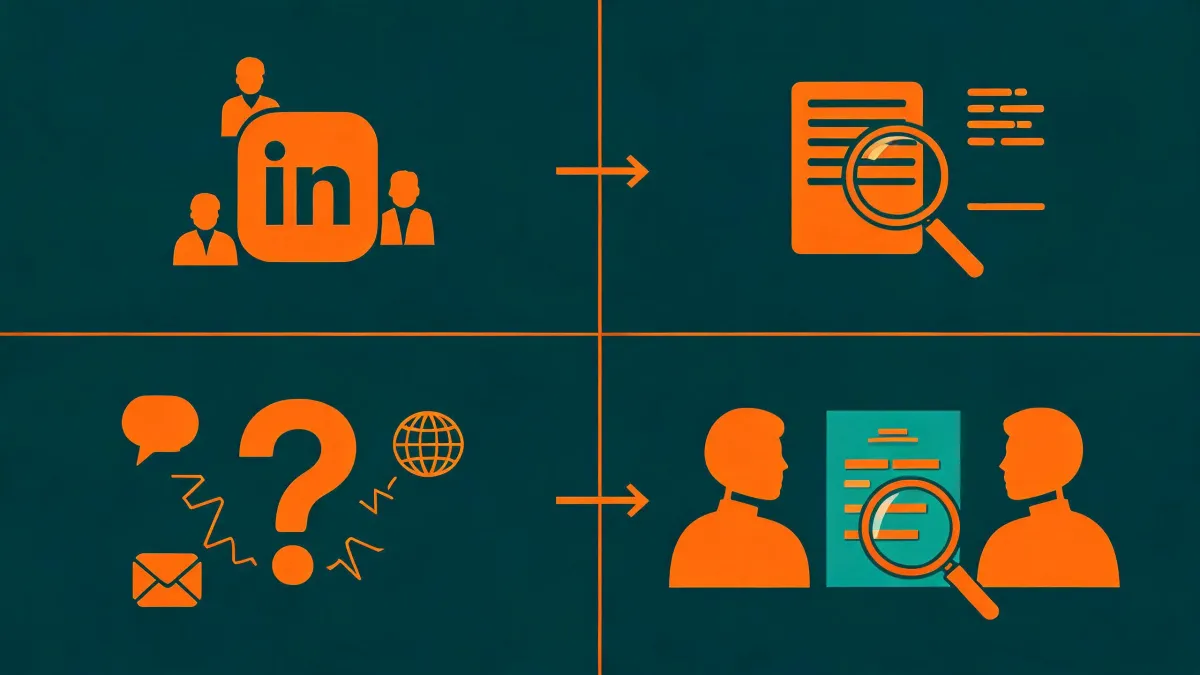
-
The Surface Problem: "Cold Email Doesn't Work"
-
The Deep Cause: Finding and Verifying Are Two Different Stages—and Most Teams Only Build One
-
The Deeper Problem: Verification Is Treated as Damage Control, Not as a Gate
-
The Cost: Bounces, Burned Domains, and Quiet Brand Damage
-
What I Look For Now: Verification Native to the Workflow, Not Bolted On
I remember the exact moment I realized cold email wasn't a copy problem.
It was Q3 2024. I was managing the tool stack for our 35-person revenue team. SDRs kept telling me cold email was dead. Open rates down. Replies basically zero. The same story you hear everywhere.
And our copy was good. We'd spent months on personalization, tweaking first lines for each prospect. All that work was landing in a void.
So I did the admin thing: I pulled the send logs.
The bounce rate was 14.3%. Almost one in seven emails never reached a human. We didn't have a verification problem. We had a verification absence problem. No email verification tool anywhere in the workflow.
That sent me down a rabbit hole. What I found changed how I evaluate sales tools from then on.
The Surface Problem: "Cold Email Doesn't Work"
The complaints show up everywhere. SDRs spend hours in an email address finder tool, export thousands of contacts, write thoughtful messages. And hear nothing back. Maybe one reply per three hundred sends.
The usual response? Blame the copy. Or the offer. Or the market.
But most teams skip a number: roughly 1 in 5 B2B email addresses goes invalid every year. Database decay is commonly cited at 20-25% annually (Source: ZoomInfo, 2024). From what I've seen managing our own contact data, that tracks. People change jobs. Companies restructure. An address that worked in January is a dead end by June.
You can write the best cold email of your career. It means nothing if it lands in a nonexistent inbox.
Yet when I look at how most sales teams architect prospecting, email verification is an afterthought. Or absent entirely. The buying conversation is dominated by finding, not validating.
The Deep Cause: Finding and Verifying Are Two Different Stages—and Most Teams Only Build One
Here's where my evaluation perspective kicked in. The market is full of email finder tools. Some pull from LinkedIn, some guess address patterns, some buy third-party databases. Their job: produce addresses.
And that's where most teams stop.
They export the addresses into an outreach tool, hit send, and hope. A thousand emails. Ten thousand. Whatever volume target they're chasing.
But finding an address and knowing it's alive are two completely different jobs.
I've only worked with mid-market B2B teams, typically 30 to 250 people. I can't speak to enterprise organizations that run their own data operations. But for everyone else the pattern repeats: find, export, send. No verification gate in between.
Let me get specific. A finder tool might guess [email protected]. The pattern could be wrong. The person could have left last week. The company could have switched email providers, changing their MX records. Any of that produces a bounce.
And when you send enough bounces, mailbox providers notice.
The Deeper Problem: Verification Is Treated as Damage Control, Not as a Gate
So the absence of verification isn't just a logic gap. It's a structural decision most teams make without realizing it.
The workflows I've audited—including our own—treated verification like damage control. We didn't have a formal verification step in our outbound SOP. That fact made the whole Q3 mess possible. You run a bulk list clean after deliverability has already tanked and your sender reputation is burned. You're cleaning up a mess you shouldn't have created in the first place.
Backwards.
That's what leads to the question I kept seeing in our documentation: how does an email verification tool fit into an agent-native prospecting workflow?
Simple answer. It's the gate at the start.
An AI SDR workflow can find a lead, enrich the record, recognize buying signals, and personalize outreach. But it all hinges on one thing: whether the email address is deliverable. Verification is the precondition. The filter that everything downstream depends on.
Like your kitchen plumbing. You don't check the pipes after the floor is flooded. You check before turning on the tap.
The Cost: Bounces, Burned Domains, and Quiet Brand Damage
Let me put a fine point on that 14.3% bounce rate from Q3 2024.
Google and Yahoo introduced bulk sender requirements in February 2024. The direction is clear: keep complaint rates low or face inbox placement consequences. The recommended threshold is to stay under 0.3% spam complaints (Source: Google Bulk Sender Guidelines, support.google.com, 2024).
Bounces feed directly into that reputation picture. Enough of them and your domain starts filtering into spam—including for prospects who would genuinely want to hear from you.
That's the death spiral. Deliverability drops, so you send more to compensate. More bounces. Worse reputation. More spam folder placements. You buy a premium sending tool or spin up a new domain, and you're back at square one. The problem was never the tool. It was the fact that nobody verified addresses before the send.
Plus there's the quieter damage. Every cold email your team sends is a slice of your brand. A bounce is noise. An email from a domain with a bad reputation looks spammy. For many prospects, your company's first impression is a spam folder notification.
When I switched from budget list sources to cleaner data with verification built in, reply quality improved. Not just deliverability—the tone of conversations. Prospects responded like they were talking to a real company, not a spray-and-pray operation. The data quality you invest in at the start shows up in how prospects perceive your brand.
And then there's morale. SDRs watching dashboards full of sent emails and zero replies. First they blame themselves. Then the tools. Then they check out. I watched motivated reps lose steam because the system made their work invisible. We estimate the total cost at roughly $18,000 in SDR hours and tool credits across two quarters. That's the real tax. It's not a line item. It's your team's time burning on a bad foundation.
What I Look For Now: Verification Native to the Workflow, Not Bolted On
This creates a specific test when I evaluate tools now.
The most common comparison I get asked about is meet alfred vs waalaxy, or meet alfred vs dux soup. On paper, those debates are about LinkedIn automation features, templates, analytics, UI preferences. Those things matter. But after the Q3 experience, my first question is different: where does verification sit in the workflow?
Is it native, built into the prospecting pipeline? Or is it a separate product bolted on the side, requiring manual exports and imports?
That's the deciding factor. And it's why I kept landing on meet-alfred when comparing platforms. It runs an agent-native prospecting workflow: find, enrich, verify, and personalize in one continuous pipeline. Verification isn't a Sunday cleanup task. It fires automatically every time a contact enters the system. That structural decision was the difference.
Is it right for every team? No. Like I said, my experience is with mid-market organizations. If your team has the resources for a complex manual stack and enjoys scrubbing lists—honestly, more power to you. But most teams don't.
Bottom line: cold email isn't dead. What kills it is sending to unverified addresses and letting the bounce spiral take over. An email address finder is only the start. A workflow without a verification gate will burn your domain, waste your team's time, and quietly damage your brand.
This was the landscape as of late 2024. Deliverability standards and tooling evolve quickly, so verify current requirements before building your stack.
Put verification at the start of the pipeline. Everything else gets easier.
The mystery, solved.

Julian Hartwell
Julian Hartwell is an independent B2B sales intelligence analyst covering contact databases, company data, decision-maker profiles, direct dials, prospect lists, and buying signals. He applies the ISO/IEC 25012 data-quality model while examining field accuracy, coverage, freshness, duplicate rate, match confidence, and source transparency. His evidence-led guides help revenue teams compare prospecting platforms, define acceptable data thresholds, and build account lists that support reliable territory planning and outreach.