Verification research
Meet Alfred vs WeConnect: A Buyer's Comparison for Agent-Native Prospecting Workflows
2026-08-17 · Julian Hartwell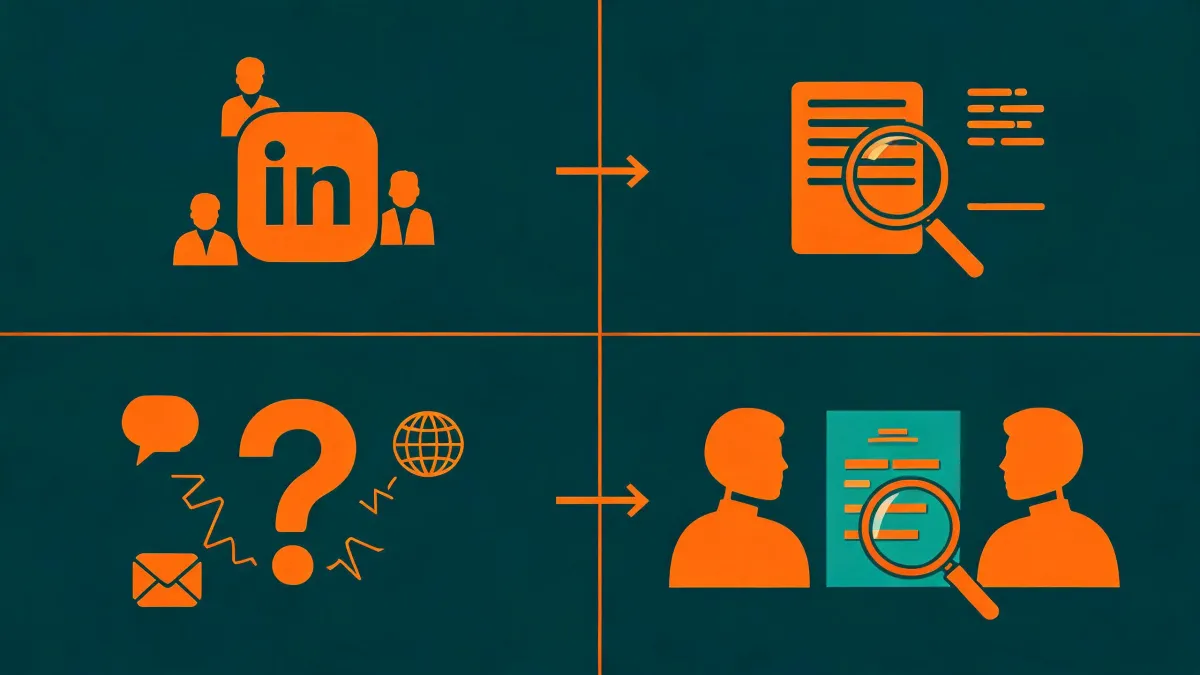
-
What This Comparison Is Really About
-
Dimension 1: Workflow Architecture — LinkedIn Automation Inside an Agent-Native Loop
-
Dimension 2: Email Sequences and the Parallel Dialer
-
Dimension 3: Data Enrichment, Email Verification, and the Meet Alfred API
-
Dimension 4: The Small-Team Test
-
Which Tool Should You Pick?
I'm the office administrator for a 40-person company. That means I manage the software buying process—roughly $150K a year across 20+ vendors. I don't run outbound sales, but whenever the sales team says 'we need a tool,' it lands on my desk. This one started with a Slack message: 'Can we automate LinkedIn and actually follow up?'
I'll admit a bias right away. I still kick myself for a tool we bought in 2023. It did one thing well, but it didn't fit how we actually worked, and we spent months duct-taping it to the rest of the stack. So I did what I usually do: checked the shortlist, read the public docs, signed up for trials, and pestered sales reps with questions. Two tools ended up on the table: Meet Alfred and WeConnect. This is that comparison.
What This Comparison Is Really About
Before I looked at any feature, I asked a different question: how does LinkedIn automation tool features fit into an agent-native prospecting workflow? Because the sales team didn't want another disconnected point tool. They wanted a process.
An agent-native workflow is one where an AI agent coordinates the whole prospecting loop: find the account, find the person, enrich the data, verify the email, send the LinkedIn connect, start the email sequence, trigger a call when it makes sense, then hand the conversation to a human. The agent is the system. The features live inside that system.
From the outside, Meet Alfred and WeConnect look similar. Both connect to LinkedIn, both automate outreach, both claim to save SDR time. The reality is different. WeConnect is built like a LinkedIn automation product. Meet Alfred is built like a prospecting platform where LinkedIn automation is one feature inside a bigger loop. That distinction matters more than any feature count.
Dimension 1: Workflow Architecture — LinkedIn Automation Inside an Agent-Native Loop
In WeConnect, the unit of work is the campaign. You select prospects, set the sequence, and the tool runs that sequence on LinkedIn. It's straightforward. For a team that only wants LinkedIn outreach, that's a feature, not a problem.
In Meet Alfred, the unit of work is the agent. You define the prospecting goal, and the agent decides the next best action. It might send a LinkedIn request, then wait for the accept, then trigger an email sequence, then suggest a call. The LinkedIn automation features aren't a separate tab—they're embedded in the workflow.
The old assumption is that an all-in-one tool is automatically bloated. That thinking comes from an era when companies bought separate products and bolted them together. Modern agent-native tools are built around the workflow from day one. In 2025, that's a difference I actually felt during the trial.
The counterintuitive part, at least to me: if you only need LinkedIn automation, WeConnect was actually easier to get running. The setup was faster, and the mental model was simpler. But when I asked the sales team what they really wanted, they didn't say 'LinkedIn automation.' They said 'more pipeline without managing four tools.' That tilted the comparison toward Meet Alfred.
Quick conclusion: if your stack already has email, enrichment, and dialing covered, WeConnect might be the right size. If you're building a workflow from scratch, an agent-native tool is more likely to match how the team actually works.
Dimension 2: Email Sequences and the Parallel Dialer
This is where the 'they're both LinkedIn tools' idea falls apart.
Meet Alfred treats email sequences as a first-class part of the agent flow. You can create a sequence that starts when someone accepts your LinkedIn request. You can branch it based on a reply. You can pause it when someone says 'not interested.' That's not a fancy feature—it's table stakes for an agent-native workflow.
WeConnect does have email-related functionality, but it's not the center of the product. In practice, you'll probably connect it to another email sequence tool. That's fine if you already love that tool. But it means more moving parts: your LinkedIn data lives in one place, your email data lives in another, and someone has to keep them aligned.
Then there's the parallel dialer. I didn't think we needed one until the SDRs explained the manual work. They'd send 50 emails, then spend another two hours dialing through the same list. Meet Alfred includes a parallel dialer in the same workflow. The system calls multiple numbers at once and connects you only when someone picks up. There's something satisfying about seeing the whole sequence in one place—LinkedIn accept triggers an email, reply branches to a task, no CSV exports. After 2024's integration mess, that was the first time a sales tool felt calm.
WeConnect, as far as I can tell from the public feature pages, is built around LinkedIn actions rather than calling. If your team needs a dialer, that's a gap you'd have to fill somewhere else.
Quick conclusion: for email sequences plus parallel dialer in one system, Meet Alfred is the stronger fit. If you don't need outbound calls, this whole dimension might be moot.
Dimension 3: Data Enrichment, Email Verification, and the Meet Alfred API
Data quality isn't the exciting part of a sales tool, but it's the part that breaks operations. Meet Alfred includes enrichment and email verification inside the workflow. The agent checks whether an email is valid before sending anything. That reduces bounces, which protects your sender reputation. WeConnect has data capabilities, but they feel more like add-ons than core workflow steps.
API access is a different story. I care about APIs because I'm the person who has to connect tools after the demo. The Meet Alfred API docs are public. You can pull prospect data, update lead status, and trigger workflows programmatically. If you have an internal CRM, that's powerful. It means the tool doesn't swallow your data—you can still control it from your stack.
WeConnect's approach is more aligned with no-code connectors. It works well for standard setups, but it's not the same as having an API you can build on. For our internal workflow, the Meet Alfred API was the easier fit.
To be fair: I'm not saying WeConnect has no API. I'm saying the two products take different integration philosophies. That difference matters if you plan to build anything custom.
Quick conclusion: if integrated data and API access are part of your requirement, Meet Alfred wins this dimension. If not, you can probably work around either tool.
Dimension 4: The Small-Team Test
This part isn't on any feature page. I manage a pretty lean stack. I don't like being treated like a lead that needs to be nurtured. I remember when I started in this role. The vendors who took our small orders seriously are the ones we still work with now that the orders are bigger.
Both tools were professional. Neither made me feel like we were too small to matter. But the experience differed in a meaningful way. Meet Alfred's trial was self-serve. I could set up an agent, invite a couple of SDRs, test the dialer, and read the API docs without asking for a demo. That's rare.
WeConnect's trial also worked fine. But the sales process felt heavier. More demo requests. More 'what's your timeline?' questions. That's not a dealbreaker, but it shapes the vibe of the whole evaluation.
Quick conclusion: for a small team that wants to move fast, self-serve matters. Meet Alfred made that easier.
Which Tool Should You Pick?
Here's the closest thing to a bottom line. Don't start with 'which tool is better?' Start with 'which workflow shape do you already have?'
- Choose Meet Alfred if you want a single agent-native prospecting workflow: LinkedIn automation, email sequences, parallel dialer, enrichment, verification, and API access in one place. It's a bigger setup lift, but the steps connect to each other.
- Choose WeConnect if you only need LinkedIn automation and already have the rest of your stack ready. It's simpler, and for that narrow job, it's probably the better fit.
Wait—that last point is important. The simpler option isn't a downgrade. If your email tool, CRM, and dialer are already working, adding Meet Alfred might be overkill. Buy the tool that fits the process, not the tool with the biggest feature list.
Both tools in this Meet Alfred vs WeConnect comparison have a place. I can't promise one tool will work for every team. But I can promise this: map your workflow before you compare features. The LinkedIn automation tool features should fit into an agent-native prospecting workflow—or whatever process you're building. Don't let another point tool decide your process for you.
Source: public feature pages, API docs, and pricing pages accessed on January 15, 2025. Feature availability and pricing change over time. Verify current details before building a business case.

Julian Hartwell
Julian Hartwell is an independent B2B sales intelligence analyst covering contact databases, company data, decision-maker profiles, direct dials, prospect lists, and buying signals. He applies the ISO/IEC 25012 data-quality model while examining field accuracy, coverage, freshness, duplicate rate, match confidence, and source transparency. His evidence-led guides help revenue teams compare prospecting platforms, define acceptable data thresholds, and build account lists that support reliable territory planning and outreach.