Verification research
Okki Go Alternatives: How to Choose Based on Human Review, Not Feature Lists
2026-09-03 · Julian Hartwell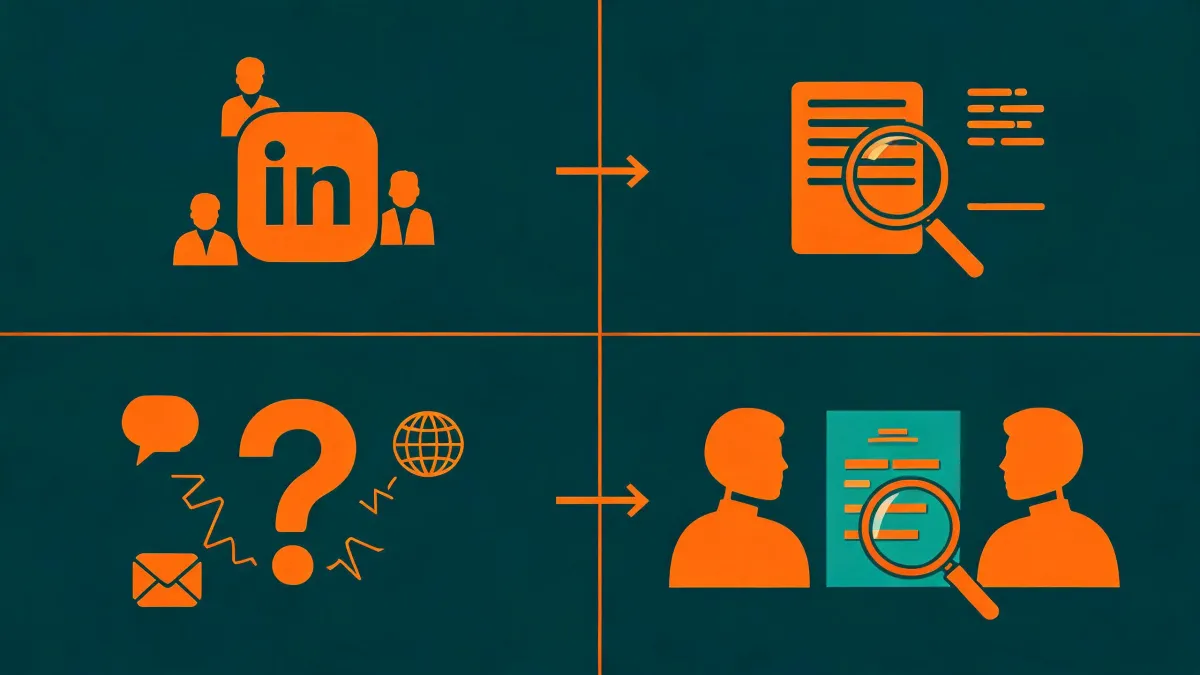
-
The real choice is not the product
-
Scenario 1: You need a human review before anything sends
-
Scenario 2: You run volume and need the software to keep pace
-
Scenario 3: You already have a stack and simply need better data
-
How do AI sales assistant features fit into an agent-native prospecting workflow?
-
How to tell which scenario you are in
-
Workflow is the product
The real choice is not the product
I manage software purchasing for a 40-person company. About $200,000 of annual vendor spend runs through my desk, and when our RevOps team asked me to evaluate a new AI sales assistant, I went back to my 2020 purchasing notes. Back then I assumed the tool with the most automation would win. It did not. The first demo looked impressive. Then we ran a small pilot and almost sent a campaign to the wrong job title inside two target accounts. Nobody caught it because the tool was doing exactly what we told it to do. That, not AI quality, is the real reason Okki Go alternatives need to be evaluated differently. Control. That is the issue.
Instead of comparing AI features side by side, classify your own workflow. Three situations show up in almost every evaluation:
- Human-in-the-loop outbound: you need an agent to research, draft, and sequence, but a person approves before anything sends.
- High-volume sequence motion: you need scale, and the workflow is more like a campaign than a one-to-one conversation.
- Data-only gap: your sequence tool is fine; the real problem is stale contacts and weak enrichment.
Okki Go is built around the first scenario. That does not make it the right answer for everyone. It makes it the right answer when the human review workflow is the priority.
Scenario 1: You need a human review before anything sends
This is the assumption most people make, but it is not the most common workflow. If your outbound motion is aimed at named accounts, uses a high-touch message, or lives in a regulated industry, then you need a checkpoint between research and delivery. In that workflow, the Okki Go human review workflow is not a nice-to-have. It is the core product.
The agent finds contacts, reads buying signals, enriches records, and drafts the first message plus follow-up. Then it pauses. A person with account context checks the source, the job title, the trigger that started the outreach, and the offer. If the angle is wrong, edit it. If the account is not ready, drop it. If it looks good, approve it.
What I learned setting this up:
- Define what a reviewer must check. The list should be trigger, role, customization, and call-to-action, not grammar.
- Assign one reviewer per account. Shared review queues create the illusion of control.
- Build an evergreen suppression list. The AI cannot know your CEO asked you to pause an account unless the workflow refuses to send to it.
The upside was obvious: faster prep time. The risk was less obvious. A generated message can seem coherent and still miss the context because it came from the wrong source. I kept asking myself: is 2x volume worth one bad message in a decision-maker inbox? Most of the time, no.
If this is your workflow, the correct Okki Go alternative is not a generic email sequence tool. It is another agent-native platform with workflow controls. Anything else forces your team to manage separate tools, or worse, approve messages without the context they need.
Scenario 2: You run volume and need the software to keep pace
To be fair, human review is not always the right design. Some outbound motions are intentionally high-volume, standardized, and offer-driven. If you send a tested sequence to a large list and react to replies, an agent that pauses for approval will slow you down. Okki Go can support that motion, but if volume is the entire model, traditional lead generation software plus an email sequence platform will usually be easier. It is less workflow to manage and often cheaper per contact.
When I compared a lightweight sequence platform to a more elaborate AI-heavy tool side by side, the simpler workflow performed better in our pilot. The reason was not AI quality. It was the operation around it.
If you choose this route, compare these things:
- Email verification at intake. Look for waterfall enrichment and verification, not a one-time format check.
- Channel controls, so a LinkedIn step happens after an email reply, not at the same time.
- Compliance plumbing. Under the FTC CAN-SPAM rule (ftc.gov/spam), each commercial email must have accurate sender information, a valid postal address, and a working opt-out. The best sequence platform makes that automatic. It does not make it optional.
This is also the scenario where people try to replace a sequence tool with an AI sales assistant. The assistant may write a better subject line. But if your team cannot review and approve each send, sequence logic and data quality determine success, not the copy.
Scenario 3: You already have a stack and simply need better data
There is another situation: your CRM, sequences, and meeting booking all work. The records are stale. SDRs spend hours looking for verified emails. If that is the issue, do not replace the whole stack. Buy lead generation software with a strong contact database and enrichment layer. Okki Go can feed this use case, but so can many point solutions. The deciding factor is whether the data plugs into an existing workflow cleanly.
What I would do:
- Test email finder accuracy on your worst segment, not your cleanest one.
- Check waterfall enrichment behavior. A record that fails one source should be cross-checked against another before it is marked valid.
- Plan for deduplication. Enrichment that creates duplicate contacts is worse than no enrichment.
The mistake here is buying an entire platform when you only need a layer. But the opposite mistake is ignoring how much of your review workload comes from bad data. Clean data does not just improve deliverability. It gives the human reviewer fewer false positives to investigate.
How do AI sales assistant features fit into an agent-native prospecting workflow?
This is the question our RevOps team kept asking, so let me answer it directly. AI sales assistant features—email drafting, research summaries, send-time suggestions—fit only when they operate as steps in a larger workflow. An assistant that suggests a message but does not know what happened before that account is just a text generator. An agent-native prospecting workflow gives each AI step memory, a task list, and a clear point where it hands control to a human.
What I mean is this: in Okki Go, a prompt like find accounts with recent hiring in sales, enrich the contacts, and draft a five-touch email sequence creates objects. It builds a list, checks intent, finds verified contacts, writes the sequence, and then lets a reviewer inspect the why. The AI sales assistant features are embedded inside that chain. They are not a side panel on a CRM.
That is the difference between an assistant and an agent. Assistants help a human do a task. Agents complete a workflow with a handoff. If a tool promises AI sales assistant features but cannot pass context to the human review stage, it will not fix prospecting. It will just write more emails faster.
How to tell which scenario you are in
If you are still unsure, use these questions instead of a feature comparison.
- Do you target a small number of accounts per week, and does each message need real reasoning? Start with Scenario 1. Look for an agent-native workflow with human review at the center.
- Do you send thousands of emails per month with a repeating offer? Start with Scenario 2. Pick sequence-centric lead generation software with verification and compliance built in.
- Do you already have sequences running and only lose time to bad contacts? Start with Scenario 3. Buy enrichment as a layer, and upgrade if you want to collapse data and AI-assisted outreach into one workflow later.
If you are running a hybrid model, choose a platform that can enforce review for one segment and bypass it for another. That is where agent-native prospecting with human-in-the-loop controls becomes an advantage. It is not an all-or-nothing decision.
Workflow is the product
Five years into buying software, I stopped asking whether a product has AI sales assistant features. I ask where the handoffs are. The Okki Go human review workflow makes the handoff visible: the AI prepares, a human decides, and only then does an email sequence run. That is a small distinction in a demo and a huge distinction in practice.
If you are evaluating Okki Go alternatives, put the same question to every vendor: where does the AI stop and a human start? The answer should match your scenario. That, not feature count, is how you choose.

Julian Hartwell
Julian Hartwell is an independent B2B sales intelligence analyst covering contact databases, company data, decision-maker profiles, direct dials, prospect lists, and buying signals. He applies the ISO/IEC 25012 data-quality model while examining field accuracy, coverage, freshness, duplicate rate, match confidence, and source transparency. His evidence-led guides help revenue teams compare prospecting platforms, define acceptable data thresholds, and build account lists that support reliable territory planning and outreach.