Verification research
Okki Go for GTM Engineers: What Data Is Required to Find Email? (And Why Certainty Actually Matters)
2026-09-04 · Julian Hartwell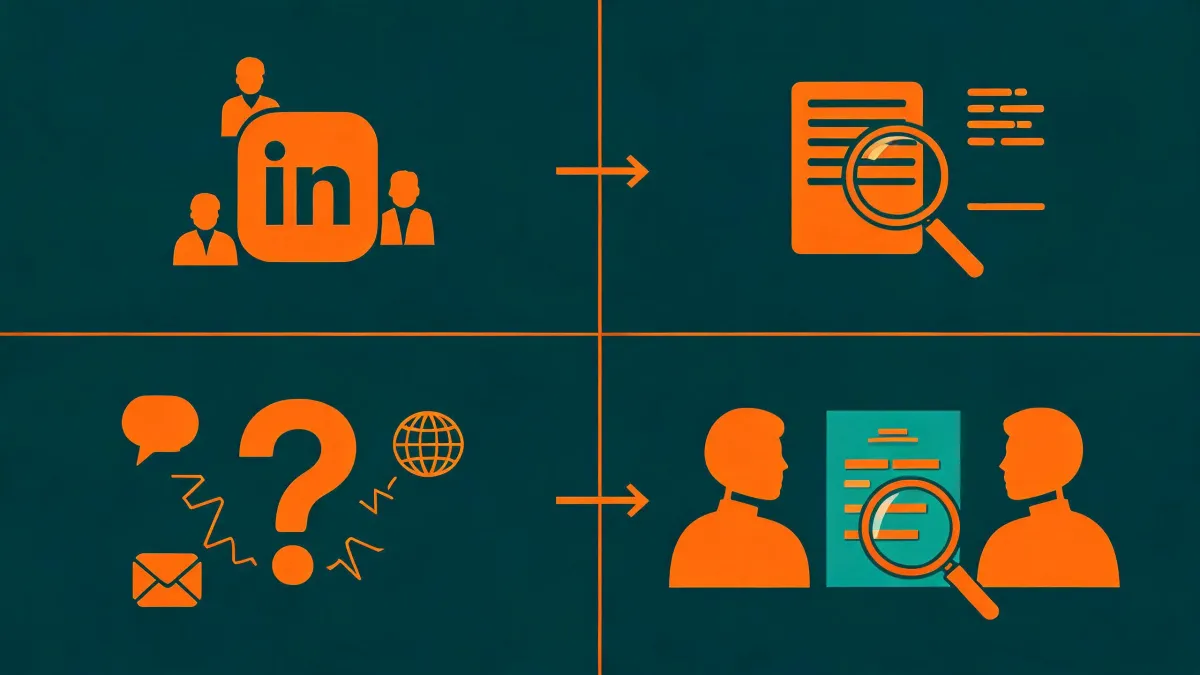
-
The Mistake That Made Me Care About Verification
-
What Data Is Required to Find Email? Less Than You Think
-
Why the Okki Go API Integration Matters More Than the AI SDR Hype
-
The Small Savings That Cost Real Trust
-
What I Check Before Connecting a Professional Email Finder
-
Sure, Some of You Will Call This Over-Engineering
-
Bottom Line
I'm a GTM engineer, and I've spent the last six years building outbound data infrastructure for B2B sales teams. I've personally made—and documented—11 significant mistakes in that role, totaling roughly $48,000 in wasted budget plus a fair amount of trust with SDRs who had every right to be annoyed. I keep a checklist now. It exists because I learned most of these lessons by ignoring the people who tried to warn me.
Here's the opinion I earned the hard way: for any team with a real deadline, certainty in your prospecting data is worth more than the premium you'll pay for a tool. A probably-valid professional email finder is not a bargain. It's a delayed disaster that bills you twice: once in subscription fees, once in broken sequences and a damaged sending domain.
That's why I stopped evaluating Okki Go as just another AI SDR product. I think of it as an API integration layer that makes data quality visible. But before I get to the tool, let me show you the mess that created this opinion.
The Mistake That Made Me Care About Verification
In March 2024, we were preparing a two-week outbound sprint for a product launch. We had a lot of raw leads from LinkedIn Sales Navigator, and my job was to package them into clean records with professional email addresses. A teammate recommended a platform with huge volume and a price that looked too good to ignore. I didn't ignore it.
We uploaded 3,800 contacts and started a sequence on a Tuesday. By Friday, 17 percent had bounced. Another chunk triggered spam complaints because we sent to stale role-based addresses. I paused the campaign and ran a full audit. The postmortem was ugly: 31 percent of the records marked verified couldn't be matched to the same person on LinkedIn Sales Navigator. We paid to damage our sender reputation, then paid again in engineering time to clean it up. After vendor credits and overtime, the total cost came to roughly $7,200 and a nine-day delay.
That's when the reverse-validation lesson landed: I only believed in verification after ignoring it. The phrase professional email finder sounds like it should mean finding valid emails. It doesn't. It means finding candidate addresses and then deciding whether to trust them.
What Data Is Required to Find Email? Less Than You Think
Whenever someone asks me what data is required to find email, I give the short answer: first name, last name, and company domain. That's enough to start the search. It isn't enough to be confident.
To make the result useful, you usually need a bit more context:
- First and last name. This sounds obvious, but missing a suffix or using a nickname changes the pattern.
- Company domain. Not just the company name, because the email format usually lives on a specific domain.
- Title or seniority. It prevents mixing two people with similar names.
- LinkedIn Sales Navigator data. A profile URL, current role, or role history helps disambiguate and can signal intent.
Here's something vendors won't tell you: the hard part isn't the lookup. It's the decision to return nothing. A low-quality tool will fill a gap with a guess, because false negatives look bad in a demo. But for a GTM engineer, a precise no is worth more than a confident maybe.
This is where Okki Go for GTM engineers stood out to me. Okki Go's agent-native prospecting starts with what you already have in your CRM and LinkedIn Sales Navigator, then goes through waterfall enrichment plus intent signals before returning an answer. If it can't confidently resolve an address, the system doesn't pretend it did. That's not a small feature. That's the whole game.
Why the Okki Go API Integration Matters More Than the AI SDR Hype
I've integrated enough data vendors to know that the API contract reveals more than the demo. Every vendor says they do AI, but when you look at the response, email is often just a string and the system acts as if the job ends there. An Okki Go API integration is useful for a different reason: it represents the uncertainty in the response. We can separate verified records, risky catch-all domains, and no-answer contacts without guessing.
For GTM engineers, this is the difference between automation that amplifies good data and automation that multiplies garbage. If you connect a platform that only returns addresses, your CRM becomes a collection of hopeful strings. If the API can say I need a human review here, then your outbound workflow has a natural stop. That's where human-in-the-loop outreach comes in. The AI agent can draft and enrich, but a person still approves the contacts that matter.
I'm not claiming Okki Go will get you 100 percent inbox placement. No tool can promise that. What the platform can do is reduce the number of false positives that reach your sequence.
People often think a better email finder leads to better reply rates. Actually, it leads to better delivery. Reply rate still depends on message quality, offer, timing, and a dozen other things. But if the address is wrong, none of those matter. The causal chain starts before the subject line.
The Small Savings That Cost Real Trust
One story sticks with me more than the big postmortem. In Q1 2025, an account executive asked me for contact at a named target company. It was a single record, so I skipped enrichment to save time and found an email with a browser extension. The address looked right. The account executive sent a proposal and followed up for a week. When the reply finally arrived, it was from a person with a similar name at a different organization, asking why she kept receiving someone else's internal budget review.
The follow-up cost wasn't one invoice. It was the account executive's confidence in the pipeline. I didn't save money; I just moved the cost to an account where I couldn't see it. Since then, the checklist has more than data fields. It also has a question about the cost of a wrong answer.
I also ask vendors a version of this: what does verified mean, and can you substantiate that claim? It's the same discipline behind FTC advertising guidance, which says claims should be truthful and supported by evidence. You don't need a law degree to apply it. When a tool says 98 percent accuracy, ask accuracy at what? If the answer is trust us, treat that as a red flag.
What I Check Before Connecting a Professional Email Finder
I maintain a short checklist now. It did not exist before March 2024. It does now:
- Does the API return a status? Can I tell a verified address from a catch-all, a probable pattern, or a no-result?
- What fields does the finder actually use? Does it accept LinkedIn Sales Navigator data and intent signals, or only name and company?
- What makes an email valid? Syntax plus domain check is not the same as mailbox-level verification.
- What happens in a dead end? Does it create a guess to protect its match rate, or does it leave the contact unverified?
- Where does a human review fit? Human-in-the-loop approval for risky or executive contacts is a feature, not a weakness.
Sure, Some of You Will Call This Over-Engineering
I hear the objection: if you have LinkedIn Sales Navigator and a decent finder, you can save money. For a small team working fifty accounts, that might be true. I wouldn't push a heavy API stack onto a founder who sends thirty emails a week.
But low volume is not the same as low uncertainty. When you're responsible for a five-thousand-contact sequence with a fixed launch date, the cost of a wrong guess is not linear. One bad email batch can poison a domain and sink the whole campaign. The cheapest option in that context isn't cheap. It's just optimistic.
I also don't frame this as Okki Go versus a manual stack. Okki Go doesn't replace your SDR team or your RevOps team. It replaces blind guessing with a decision point. If you already have a tool that gives you verification statuses and honest no-answers, use it. If you don't, you're not saving time; you're deferring it.
Bottom Line
The premium you pay for a prospecting tool isn't for speed. It's for certainty. Certainty means knowing, before your SDR spends time on a lead, that the email address has a reasonable chance of being correct.
That is the lesson I keep documenting for new team members. Okki Go API integration won't guarantee reply rates. It won't make a weak offer sound strong. It won't promise perfect deliverability. But it can solve the problem that cost me nine days: it makes data quality honest, and it gives a human the chance to say no.
So when someone asks what data is required to find email, I say start with name, company domain, and LinkedIn Sales Navigator data. Then ask what happens when the data isn't enough. Ask what the API returns. Ask where a human still gets to approve. That's the certainty you're actually buying.

Julian Hartwell
Julian Hartwell is an independent B2B sales intelligence analyst covering contact databases, company data, decision-maker profiles, direct dials, prospect lists, and buying signals. He applies the ISO/IEC 25012 data-quality model while examining field accuracy, coverage, freshness, duplicate rate, match confidence, and source transparency. His evidence-led guides help revenue teams compare prospecting platforms, define acceptable data thresholds, and build account lists that support reliable territory planning and outreach.