Verification research
Okki Go Permissions, Alternatives & Buyer Intent Data: A Scenario-Based Guide
2026-09-08 · Julian Hartwell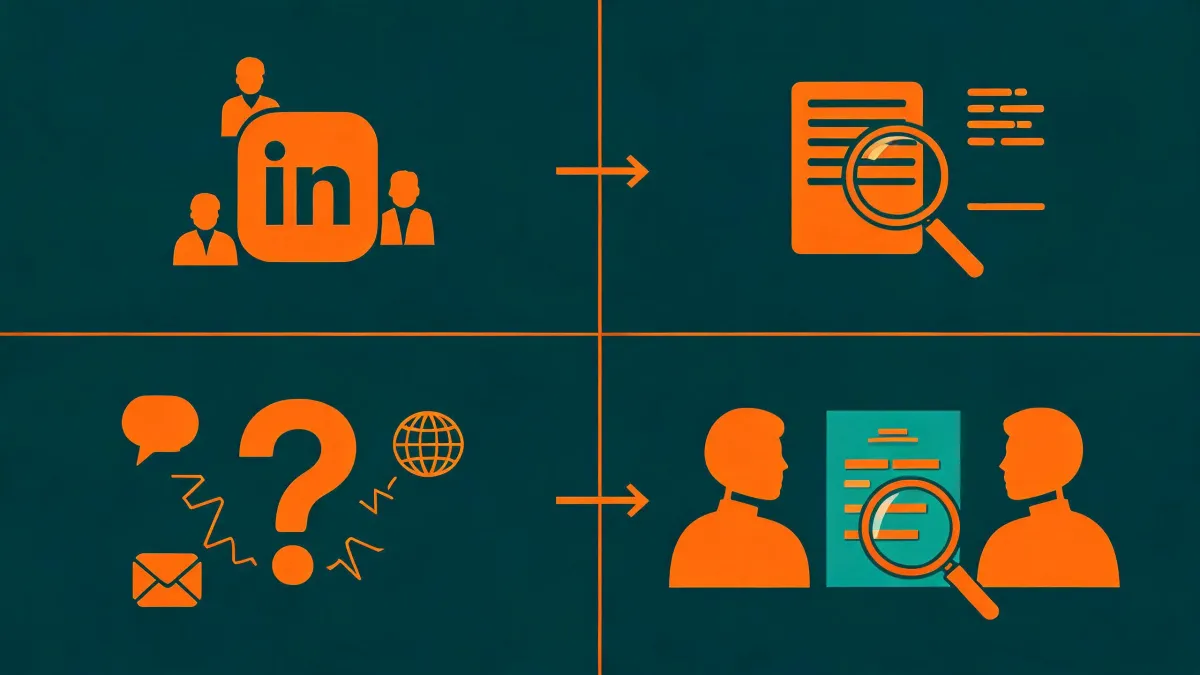
-
Three ways to evaluate Okki Go
- Scenario 1: You need to answer "what permissions does Okki Go require?"
-
Scenario 2: You're comparing Okki Go alternatives for agent-native prospecting
-
Scenario 3: You're buying intent data and wondering what a buying intent signal actually is
-
How to tell which scenario you're in
If you're evaluating Okki Go for your sales team, you're probably asking one of three questions. What is being connected to our stack? Is there a better option for agent-native prospecting? And will the buyer intent data justify the price?
I handle the purchasing side of our revenue stack, so those questions land on my desk before any pilot starts. I don't write the outreach—I sit in the security reviews, look at the permission screens, and ask the slightly annoying questions that nobody else wants to ask. So I've stopped looking for a single verdict on Okki Go. The right answer depends on which stage of the buying process you're in.
Three ways to evaluate Okki Go
Use this as a rough decision tree. Each path is a different conversation.
- Scenario 1: You're in the permission review. You want to know what Okki Go requires before you connect LinkedIn, email, or a CRM.
- Scenario 2: You're comparing Okki Go alternatives for agent-native prospecting. You care less about the exact vendor and more about the workflow.
- Scenario 3: You're buying intent data or trying to make sense of buying intent signals. You need to know whether LinkedIn scraping is a data source or a compliance risk.
Scenario 1: You need to answer "what permissions does Okki Go require?"
Late last year, we almost approved a sales tool because the demo looked great. Then our IT lead opened the permission screen and saw it wanted full mailbox access. Looking back, I should have asked about permissions before the demo. At the time, I was focused on the sales workflow, not the access boundary. That was a rookie mistake.
So let's be direct about Okki Go. The exact permission list changes between versions and integrations, so I'll give you the categories I'd expect in an agent-native prospecting workflow rather than a guaranteed string of text:
- LinkedIn access. Enough to observe the profiles your team is already looking at and move a qualified lead into outreach.
- Email send access. Usually a send-capable scope so the AI assistant can create and send follow-ups. It should not need the right to read your entire inbox or delete messages.
- CRM read/write access. Limited to the objects the workflow touches, such as leads or sequences, not every admin feature in Salesforce or HubSpot.
If a permission prompt asks for something broader than that, ask the vendor why. "Because the agent needs it" is not an explanation. Okki Go is built around human-in-the-loop outreach, so you should be able to see and approve actions before they run. The permissions should match that design.
What about LinkedIn scraping in this permission review?
This is the part everyone wants to skip. How does LinkedIn scraping fit into an agent-native prospecting workflow? The polite answer is: as one input, not the whole data strategy. The agent reads the profile in front of you, enriches it with firmographic and intent data, and then drafts an action for a human to approve. It shouldn't be exporting LinkedIn's entire database into your warehouse.
According to LinkedIn's User Agreement (linkedin.com/legal/user-agreement), automated scraping of the platform without permission is not something you should assume is safe. To be fair, some integrations operate through official APIs or browser actions initiated by the logged-in user. That is a different risk profile from mass profile harvesting. The test is whether the tool behaves like a user on LinkedIn or like a crawler hiding behind one.
If a vendor cannot explain that difference to you, do not hand them your SDR team's LinkedIn connections.
Scenario 2: You're comparing Okki Go alternatives for agent-native prospecting
The phrase "agent-native" gets thrown around a lot. To me, it means the software starts with an autonomous agent that makes decisions—who to contact, what to say, when to follow up—rather than a fixed automation sequence with a little AI copywriting sprinkled on top.
Okki Go is not the only option in that category. I've evaluated several Okki Go alternatives for agent-native prospecting, and they tend to fall into two groups:
- All-in-one AI SDR platforms that handle research, enrichment, outreach, and reporting under one roof.
- Modular agent stacks that combine intent data, enrichment, and an AI workflow tool your RevOps team controls.
Honestly, the modular stack is more flexible than a one-size-fits-all platform. But it also takes longer to set up. If your team's operating rhythm is "monthly experiment, not a six-week build project," choose the easier path.
Here are the three criteria I use when comparing agent-native tools:
- Can you see the reasoning? If the agent can't tell you why it contacted a specific lead, it's a black box with a send button.
- Is there a human checkpoint? The tools that survive our vendor review all let SDRs approve or edit before anything goes live.
- Does it respect small pilots? This is personal. I'll always stand behind the idea that small customers deserve real service. When I was starting out, the vendors who treated my $200 orders seriously were the ones I later trusted with bigger budgets.
The most frustrating part of this category is that many alternatives claim to replace an SDR. I don't want a tool to replace my team. I want it to take over the repetitive parts so the humans can do the relationship work. Any Okki Go alternative that feels like a solution to "people who send emails" probably isn't ready for a serious RevOps stack.
Scenario 3: You're buying intent data and wondering what a buying intent signal actually is
Buyer intent data is a separate decision from the prospecting tool. You can have the cleanest agent-native workflow in the world and still send great messages to the wrong accounts if your intent data is weak.
First, define a buying intent signal. In B2B, a buying intent signal is an observable action suggesting a company is actively researching a solution. It is not merely having the right job title. Someone can be a perfect ICP match and not be in the market until next year.
- First-party intent: Someone visits your pricing page, downloads a comparison guide, or searches for your tool's alternatives. This is usually the strongest signal.
- Third-party intent: A person at a target account starts publishing content about the problem you solve or visiting review sites in your category.
- Firmographic intent: The company hires roles that imply they are building outbound capacity or investing in AI sales tools.
Buyer intent data providers typically fall into the second and third buckets. Some of the best-known providers include Bombora, 6sense, Terminus, and G2 Buyer Intent. I'm not trying to rank them, because the right provider depends on your market, your account list, and whether you need anonymous website resolution.
Here's where I see teams go wrong—and I include myself in this. They confuse LinkedIn activity with buying intent. A LinkedIn scraping workflow can tell you that the head of SDR just liked a post about AI prospecting. That is a topic interest, not a purchase signal. It might be a useful research hint, but acting on every hint will annoy more prospects than it converts.
The better workflow is a waterfall: start with a verified contact, layer on an intent spark, enrich with firmographic data, then let the agent decide whether the lead is worth a human's attention. LinkedIn gives you freshness and context. Intent data gives you timing. Neither works alone.
Take this with a grain of salt, but if I had to pick one thing to fix in a struggling outbound motion, I'd fix the data inputs before touching the AI. Agent-native prospecting cannot manufacture demand signals out of thin air.
How to tell which scenario you're in
People sometimes expect me to end with "try Okki Go and see." That's not useful advice. Instead, ask yourself which checkpoint is holding you back:
- If you're stuck in a security review, focus on permissions. Do a trial with restricted access and make the vendor explain every scope.
- If you're comparing Okki Go alternatives, focus on workflow transparency. Write down the ten actions your team performs every day and check which tool can truly own them.
- If you're not sure whether buyer intent data providers are worth the money, start with first-party intent and one third-party source. Then measure whether the signal changes what your SDRs do, not just where they point.
One last note: per FTC advertising guidance (ftc.gov/business-guidance/advertising-marketing), claims like "guaranteed reply rate" or "100% accurate email verification" are red flags unless they are substantiated. I'll admit I'm pickier about that than most buyers. But I've been burned by vendors who promised the world and delivered a CSV. I'd rather use a tool that over-communicates what it can't do.
And if a smaller vendor gives you real answers and a human on the phone, don't dismiss them. Today's underdog can be tomorrow's most reliable partner. That's not a soft slogan—it's how I've built a vendor list I actually trust.

Julian Hartwell
Julian Hartwell is an independent B2B sales intelligence analyst covering contact databases, company data, decision-maker profiles, direct dials, prospect lists, and buying signals. He applies the ISO/IEC 25012 data-quality model while examining field accuracy, coverage, freshness, duplicate rate, match confidence, and source transparency. His evidence-led guides help revenue teams compare prospecting platforms, define acceptable data thresholds, and build account lists that support reliable territory planning and outreach.