Verification research
Okki-Go Outreach Preparation Workflow: Where LinkedIn Sales Navigator Automation Fits an Agent-Native Prospecting Stack
2026-09-22 · Victor Okeke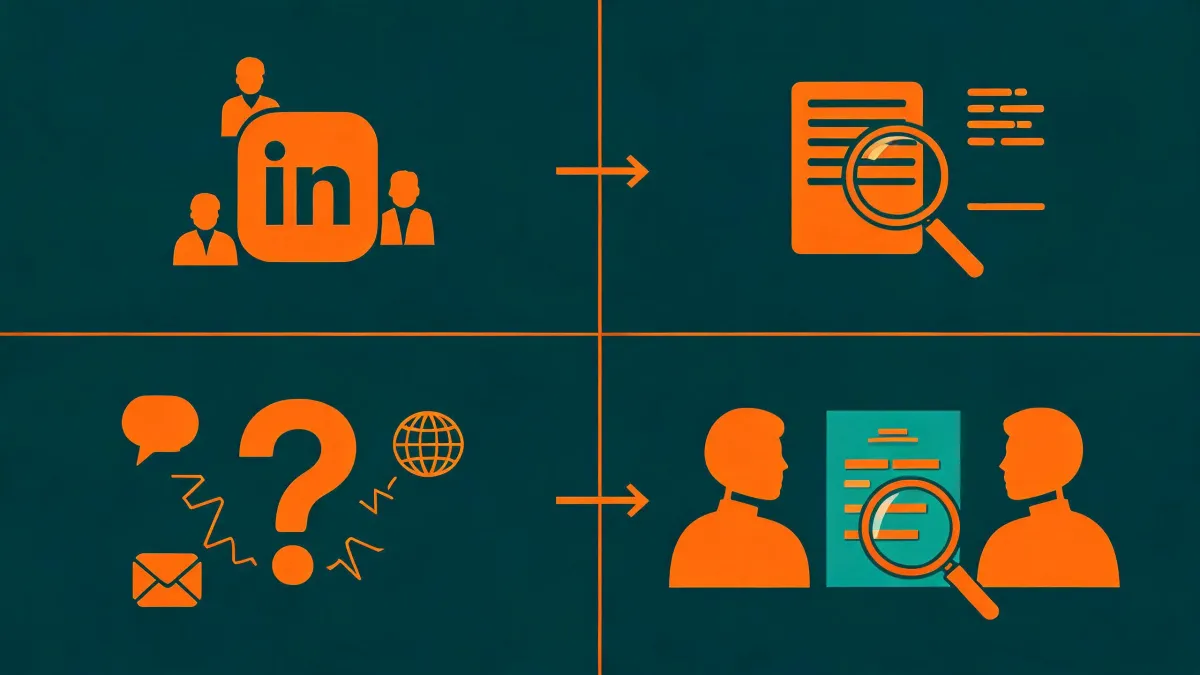
-
The problem you think you have: not enough LinkedIn outreach
-
The deeper problem: Sales Navigator automation is a search layer, not a workflow layer
-
The real bottleneck: fragmented data and manual handoffs
-
What a broken prep workflow actually costs
-
Where Okki-Go fits: an Okki-Go outreach preparation workflow for SDR teams
-
If you're evaluating this for your team
The problem you think you have: not enough LinkedIn outreach
If you're running SDR teams, you've probably heard some version of this: “We just need more leads.” More Sales Navigator seats. More saved searches. More connection requests. More sequences. The assumption is that LinkedIn outreach is a volume game, and the team that sends the most messages wins.
I get it. In March 2024, I was 36 hours away from launching a post-webinar sequence for 1,200 registrants. We had a Sales Navigator list, a CSV export, and a lot of confidence. Then the handoffs started breaking. Half the emails were missing. Some titles were stale. No one had checked for intent signals. One SDR spent four hours copying LinkedIn URLs into an enrichment tool (again). We missed the first send window, and the follow-up landed after a competitor's.
That launch changed how I think about outreach prep. It wasn't a copy problem. It wasn't a LinkedIn automation problem. It was a workflow problem.
The deeper problem: Sales Navigator automation is a search layer, not a workflow layer
LinkedIn Sales Navigator is good at what it's designed to do: search, filter, save lists, alert you when people change jobs, and show relationship paths. If you're asking, “How does LinkedIn Sales Navigator automation fit into an agent-native prospecting workflow?” the honest answer is: as a discovery and signal layer. That's it.
It doesn't resolve identity across systems. It doesn't run waterfall enrichment. It doesn't verify emails, enrich phone numbers, or tell you which account is actually in-market. It can't decide whether a contact should be routed to an SDR, an AE, or a nurture sequence. And it definitely doesn't clean your CRM.
So when teams bolt Sales Navigator automation onto a broken prep process, they don't get leverage. They get faster chaos. The CSV still has duplicates. The job titles are still stale. The email verification happens too late. The agent, if there is one, is reading messy data and making messy decisions.
I only believed this after ignoring it (unfortunately). In 2023, we tried to save a few hundred dollars by skipping full waterfall enrichment on a 3,000-contact list. We used the cheapest data path and pushed the sequence anyway. Bounce rates spiked, our sending domain got throttled for nine days, and two enterprise follow-ups hit after the prospect had already signed with someone else. That was a $1,200 “savings” that cost us a $15,000 pilot. We've budgeted for reliable data prep ever since.
The real bottleneck: fragmented data and manual handoffs
Here's what most SDR leaders miss. The bottleneck isn't lead volume. It's the number of manual handoffs between systems. Sales Navigator to CSV. CSV to enrichment tool. Enrichment tool to verification tool. Verification tool to CRM. CRM to sequencing tool. Every handoff adds delay, creates errors, and makes the workflow impossible for an AI agent to run reliably.
A B2B contact data platform should be the connective tissue, not another tab. But many platforms still operate like lookup tools: you ask for a contact, you get a record, and you're on your own for verification, intent, deduplication, and routing. That's fine for one-off research. It's terrible for a rush outreach sprint.
Agent-native prospecting changes the expectation. An agent should be able to read a signal, call enrichment sources, verify the result, check intent, score the account, and draft outreach for human review. But agents don't fix bad data. They amplify it. If your prep workflow isn't structured, agent-native prospecting just gives you more confident mistakes.
Per FTC guidelines (ftc.gov), advertising claims must be truthful, not misleading, and substantiated with evidence. That's worth remembering when any vendor promises guaranteed reply rates or 100% verified contacts. Those claims are red flags, not proof.
What you can buy is certainty in the process. Not certainty that someone will reply. Certainty that the contact is real, the data is fresh, the enrichment is complete enough to act on, and the sequence won't damage your domain. In an emergency, that certainty is worth paying for.
What a broken prep workflow actually costs
The invoice is never just the tool subscription. The real costs show up as:
- SDR hours wasted on copy-paste and list cleanup (honestly, the most expensive data entry you'll ever pay for).
- Deliverability damage when bad emails bounce and domains get throttled.
- Missed windows when a competitor reaches the account first.
- CRM debt that RevOps has to clean up later.
- Lost trust from sales leadership when “the list was ready” turns out to be “the list was exported.”
I have mixed feelings about paying a premium for data and workflow tools. On one hand, it feels like a tax on basic execution. On the other, I've seen what a 48-hour delay costs. When a quarter is closing or an event follow-up is cooling, “probably good enough” is the most expensive option on the table.
The alternative—cheap, uncertain data—isn't actually cheap. It just moves the cost to your SDRs, your domain reputation, and your pipeline. That's the time certainty premium in practice: you're not paying for speed alone. You're paying to remove the risk of a broken handoff at the worst possible moment.
Where Okki-Go fits: an Okki-Go outreach preparation workflow for SDR teams
This is where Okki-Go comes in. Not as a replacement for SDRs or RevOps. Not as a magic reply-rate button. Okki-Go is built for an agent-native prospecting workflow: it takes signals from sources like LinkedIn Sales Navigator, runs waterfall enrichment and intent data, verifies contacts, and routes outreach drafts to humans for review.
For an Okki-Go outreach preparation workflow, the handoffs look more like this:
- LinkedIn Sales Navigator automation feeds saved searches, alerts, and account lists into Okki-Go as discovery signals.
- Okki-Go runs waterfall enrichment across multiple sources, fills gaps, deduplicates, and checks intent.
- An agent prioritizes accounts and drafts outreach based on role, account, and signal.
- An SDR reviews, edits, and sends. Human-in-the-loop outreach stays human.
For Okki-Go for SDR teams, the value isn't “more automation.” It's fewer broken handoffs. Less CSV wrangling. Cleaner routing. A B2B contact data platform that's actually part of the workflow instead of another tab that creates work.
And for the specific question—how does LinkedIn Sales Navigator automation fit into an agent-native prospecting workflow?—it fits at the top of the funnel. Let Sales Navigator find and monitor the accounts. Let Okki-Go enrich, verify, score, and prepare. Let humans handle the conversation. That's the split that keeps LinkedIn outreach from turning into a spam cannon.
If you're evaluating this for your team
Don't start with “Which tool sends the most messages?” Start with “Where does our prep workflow break under deadline?” If the answer is data gaps, manual enrichment, stale titles, or missing intent, then an agent-native prospecting layer is worth a look. Okki-Go can help compress that prep cycle, but it won't replace judgment. Nothing should.
Bottom line: LinkedIn Sales Navigator automation is useful. It's just not the whole workflow. If you're running SDR teams and relying on it for outreach prep, you're probably paying for certainty somewhere else—or paying for uncertainty with your pipeline.

Victor Okeke
Victor Okeke is an independent sales technology procurement analyst covering lead-generation software, contact data platforms, email verification, AI prospecting tools, sales engagement systems, enrichment services, and CRM integrations. He reviews ISO/IEC 27001 and ISO/IEC 27701 evidence alongside data rights, retention, export controls, uptime, usage limits, implementation effort, cost per validated contact, and contract terms. His buying guides help revenue and procurement teams compare pricing, trials, integrations, governance, and measurable value before committing to a platform.