Verification research
What Is a Prospecting Tool and When Should a B2B Sales Team Use One? Notes From Our okki-go Workflow Rebuild
2026-10-09 · Lena Kovacs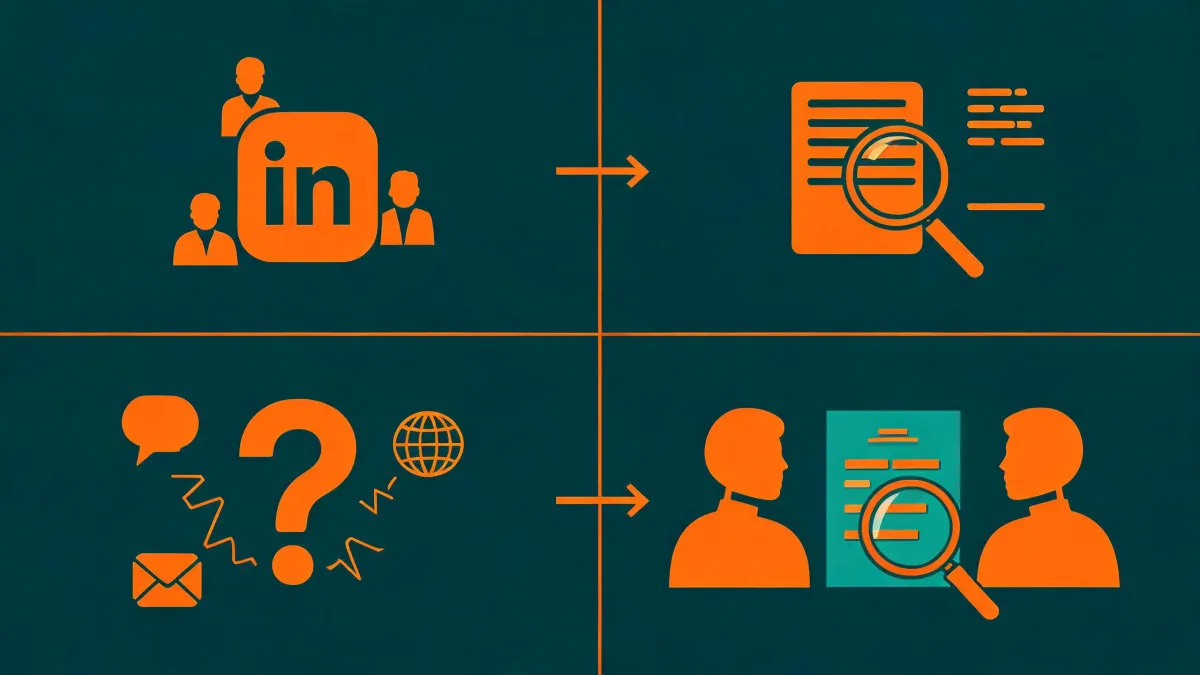
-
The bounce rate that blew up my quarter
-
The process — or, why buying a tool doesn't fix a broken workflow
-
The turn — and where my gut fought my spreadsheet
-
What the okki go workflow actually looks like for an SDR team
-
So what is a prospecting tool, actually?
-
Cost, and why I now pay for certainty
-
Where I'm still uneasy
The bounce rate that blew up my quarter
January 17, 2025. I was reviewing the week's outbound report from our SDR team. 500 emails sent to a list of 1,500 contacts. Bounce rate: 7.3%. That's roughly 110 emails that never reached anyone.
That number wasn't just bad. It was embarrassing, because we'd supposedly fixed this back in 2024. We cleaned the list manually. We ran "enough" email validation to feel responsible. If by "enough" you mean "patching it whenever a problem showed up."
I own sales lead quality — basically, everything that flows into the SDR queue passes through me before it goes out the door. So a 7.3% bounce rate wasn't just their problem. It was mine.
Later that week I did the math. At our average of about 20 records per SDR hour spent on manual research and correction, we were burning almost 14 work-hours a week on data cleanup. That doesn't count the deliverability risk to our domain or the SDR morale cost of dialing ghosts. At that pace we were going to either hire another data person in 2025 or accept that our outbound program was slowly poisoning itself.
That's when I finally sat down and asked the question most teams ask way too late: What is a prospecting tool, and when should a B2B sales team actually use one?
The process — or, why buying a tool doesn't fix a broken workflow
In early February I pulled five tools into an evaluation. Some lean data. Some lean outreach. Some trying to be both. okki go showed up on my list after a RevOps friend of mine mentioned their waterfall enrichment plus intent layer had stopped a similar bleed at his company.
I was skeptical. Every "AI sales intelligence" demo I'd seen up to that point ended the same way: a slick dashboard, a lot of rows, and zero clarity on whether any of those rows were fresh.
Still, I set up a trial. My first workflow (naive, and in retrospect, instructive) was this: dump all 10,000 target contacts into okki go, run enrichment, and let the SDR team hit anything that came back with a phone number and a work email.
It didn't work. Not because the tool failed — because I failed. I hadn't defined the ideal customer profile. I hadn't told the system which fields actually mattered to us. I handed it a spreadsheet stitched together from three sources and expected it to invent structure.
That first week, honestly, is where most teams give up and write the "tools don't work" post. They blame the tool for a mess they brought to it.
The turn — and where my gut fought my spreadsheet
I started over. This time I did two things first:
- Defined the fields that mattered to our ICP (industry, headcount, last funding round, tech stack signals, seniority level).
- Used okki go's waterfall enrichment workflow to match against intent data — not "fill in everything we can find," but "find what's actually usable."
Here's where the causation reversal kicked in, and it's the thing I keep coming back to. People think more data leads to better outreach. It's the opposite. Cleaner data leads to better outreach, which means you can work smarter on fewer contacts. The causation runs the other way. I'd been assuming volume was the lever. It wasn't.
Around mid-March 2025, I ran two parallel lists for two weeks:
- List A: a cheaper data provider returning roughly 200 fields per company.
- List B: okki go, returning about 40 fields per company — but every one verified and timestamped.
On paper, the numbers said go with A. Five times the data at a lower cost. My gut said stick with B. I sat on that decision for three days, which felt longer than it was.
I went with B. Why? Because SDRs don't consume fields. They consume context they can act on. Forty accurate fields beat 200 fields that are mostly stale or guessed.
The March numbers backed it up. Reply rate on the B list was roughly double the A list — but the difference wasn't the tool, it was that the SDRs trusted the data enough to actually pick their battles.
What the okki go workflow actually looks like for an SDR team
The system we ended up with runs monthly. Roughly:
- Pull target contacts from our curated account list.
- Run waterfall enrichment (firmographic layer first, then contact-level data via LinkedIn, then email validation as the final gate).
- Overlay intent data to only keep accounts showing recent relevant activity signals.
- Push verified contacts into our outreach tool.
End-to-end, that process took... let me check, because people always ask. For our volume, it went from "most of an SDR week" to "one afternoon, run by one person working half a slot."
The piece I underrated going in: the waterfall aspect (meaning multiple sources chained, each one validating the last) isn't about stacking sources. It's about cross-checking. That's why it feels different from a single-source tool — every additional pass either confirms or catches a lie in the previous one.
So what is a prospecting tool, actually?
If someone asks me that today, here's my answer:
It's the software layer between your ICP and your outreach system that verifies, enriches, and prioritizes — so your SDRs spend their time talking instead of doing reconnaissance in a spreadsheet.
And when should a B2B sales team use one? This is the more honest, less comfortable answer:
Use one when:
- You're processing more than a few hundred contacts a week.
- You've got enough inbound or sourced volume that manual verification is no longer viable.
- Your domain deliverability is starting to care about your data hygiene.
- Your SDRs are spending more time researching than talking.
Don't use one when:
- Your pipeline is under a few hundred targets (just do it by hand, save the money).
- You're pre-product-market-fit — clean data doesn't fix a wrong message.
- You haven't defined your ICP (a tool can't fix that; it'll just help you scale the noise).
Cost, and why I now pay for certainty
okki go isn't free. It's more expensive than the cheap "100% accurate" alternatives — mostly because those claims don't hold up (in my experience, no verification tool hits 100%, and anyone promising that is selling you a line).
But here's the math I keep coming back to. A cheap tool in B2B outbound gets expensive fast — not in email verification costs, those are pocket change, but in three invisible costs:
- Hours your SDRs can't trust the data.
- Damage to your domain reputation from bounces and complaints.
- Accounts you never touched because a field was wrong and the record got filtered out.
Total cost of ownership, our whole sales intelligence stack came out to about 15% more than the cheaper version we'd been running. For the 14 hours a week back, and the bounce rate dropping from 7.3% to 1.4%? That's not even a question anymore.
Which is also why paying for certainty is something I now budget for deliberately. I approved a cheaper validation tool in Q2 2024 to save a few thousand dollars. We spent more than that in re-verification, re-sending, and repairing domain reputation. I still kick myself about it.
Where I'm still uneasy
I have mixed feelings about okki go and this whole category. On one hand, it solved a real bottleneck and it earns its keep. On the other, tools like this make it way too easy to run large-scale low-quality outreach. Nothing stops a team from using it to send 500,000 "personalized" emails a day and ruin it for everyone.
My compromise: use it as an amplifier, not an exoskeleton. Amplifiers assume you already know where you're going.
If you're a B2B sales leader trying to figure out when to bring in a prospecting tool, here's my read: fix your ICP and your process first, then bring in a tool for the parts where data accuracy and time certainty are non-negotiable. Not before. And not because it's the cheaper option.

Lena Kovacs
Lena Kovacs is an independent AI sales agent analyst covering AI SDRs, autonomous prospecting, research agents, email writers, personalization systems, sales assistants, and outbound workflow automation. She applies ISO/IEC 42001 governance concepts while testing task completion, factual accuracy, hallucination rate, approval controls, response latency, personalization relevance, escalation behavior, and auditability. Her evaluations help sales leaders determine where agentic workflows can improve productivity, where human review remains necessary, and how to compare automation claims with measurable outcomes.