Verification research
What Is LinkedIn Sales Navigator Export? A 72-Hour Prospecting Fire Drill with Meet-Alfred
2026-08-18 · Julian Hartwell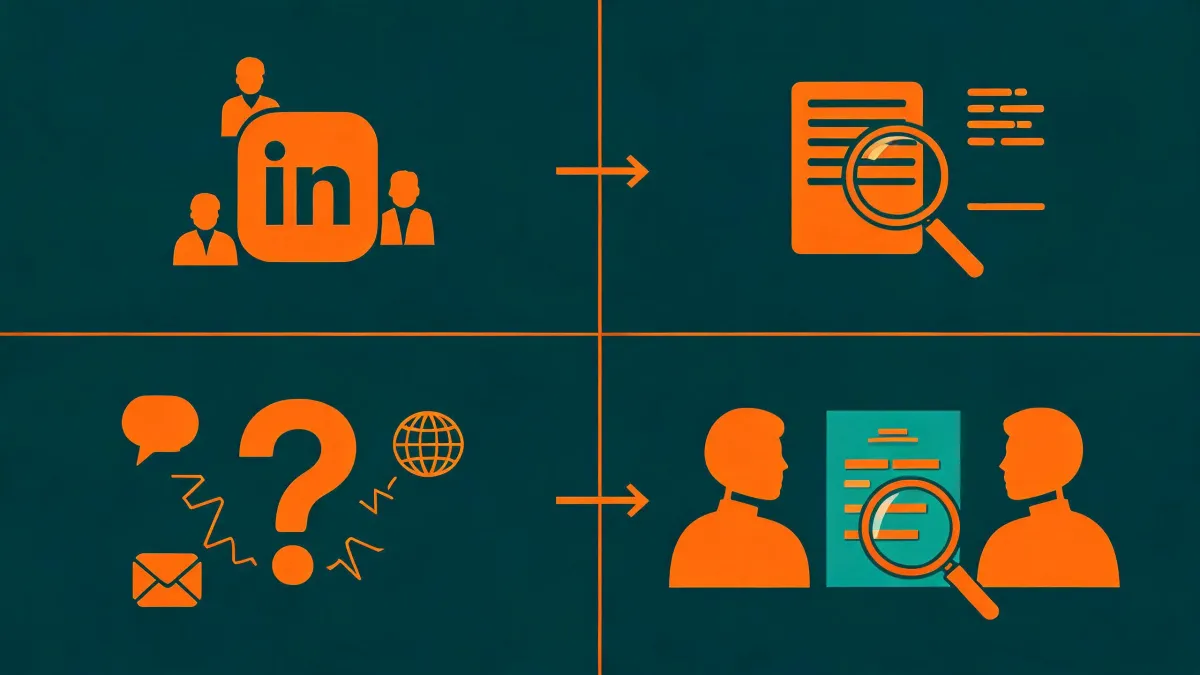
It was 3:47 PM on a Thursday in March 2024. Our VP of Sales dropped a Slack message that made my stomach drop.
"We need 500 target accounts with decision-maker contacts by Monday morning. Can you make that happen?"
Not "can you start on it." Not "what's a realistic timeline." It was a 36-hour deadline, and the CEO was going to walk into a board meeting with our Q2 outbound plan. We had an empty CRM, a Sales Navigator seat, and no export pipeline set up yet.
In my role coordinating prospect-data requests for a B2B SaaS company, I've become the person who gets calls like this. I've handled 40+ rush list-building requests in four years, and I've learned that the difference between a good emergency list and a bad one comes down to the word "export."
What Is LinkedIn Sales Navigator Export and When Should a B2B Sales Team Use It?
LinkedIn Sales Navigator export is the process of taking a search result — accounts, leads, ICP filters — and moving it into a format your sales team can actually use. That might be a CSV, a CRM list, or a ready-to-launch sequence in an outreach tool.
Most people think native export does this. It doesn't, not fully. Native Sales Navigator export lets you pull leads and accounts in batches, but what you get is often a CSV with LinkedIn URLs and basic firmographics. You don't get verified work emails. You don't get phone numbers. You don't get intent triggers, or a lead score, or a personalized first line for every prospect.
That's why "export" can turn into a mess.
I said "export the leads." The rep heard "download the CSV." Result: we got a CSV. We just couldn't do anything with it.
We were using the same word but meaning different things. Discovered this when the rep hit send on the first batch and three out of four emails bounced. Not ideal.
Based on that night and every rush request since, I now tell sales leaders to use Sales Navigator export when:
- You need more than a handful of contacts and manual copy-paste becomes a bottleneck.
- Your team needs enriched data — email addresses, phone numbers, recent triggers, tech stack — attached to each LinkedIn profile.
- You're launching a multi-channel sequence involving LinkedIn connection requests, email, and maybe direct mail, and the lists need to match.
- You need a repeatable process, not a one-off list for a single campaign.
If you only need 20 local prospects and a personal intro, skip the tooling. But once volume or speed becomes a factor, a purpose-built export workflow is the difference between a list and a pipeline.
The Cheap Option Wasn't Cheaper
Back to that Thursday. We had two choices. Option one was a $29/month browser scraper that claimed it could export Sales Navigator results. Option two was meet-alfred, which we'd used for a smaller pilot, and which was a few hundred dollars more for the team plan.
$29 vs. a few hundred. For about 30 seconds, the $29 option sounded logical. I do not think the $29 scraper was malicious. It just wasn't built for the moment.
Then I remembered February 2023.
We had a similar rush request for a trade show list. We tried to save money on a cheap export tool. The list arrived with 4,000 contacts but zero email verification. 40% of the emails bounced, our sales team spent a morning cleaning data, and the follow-up that mattered was late. We didn't lose the account because of it, but we lost credibility with our own sales team. That's the kind of thing that sticks.
That's when we implemented our "verified or it didn't happen" policy for prospecting data.
So on Thursday we went with meet-alfred. Not because it was perfect, but because it was predictable.
What Meet-Alfred Changed
Meet-Alfred is a Chrome extension that runs on top of Sales Navigator and connects the whole prospecting workflow. It's not just an export button. The sales AI agent inside meet-alfred did the heavy lifting on that list build.
We set the filters:
Target accounts in healthtech and fintech
Company size 50–500
Titles: VP Sales, Head of Growth, CRO
Intent data: recently hired executives, actively hiring, using competing sales tools
Then the AI agent went to work.
Within 45 minutes, we had 486 accounts and 1,204 contacts. Each contact had a verified email, a LinkedIn profile, a company size, and a personalized note draft. The email verification stage was built into the workflow, so the bounce rate on that batch was under 2%.
We still had to review the list. The AI agent made the first pass; a human made the final call. But the process that took us two days before took us one afternoon.
We also used meet-alfred to send LinkedIn connection requests with personalized notes. The AI agent pulled a recent trigger for each prospect — a job change, a funding announcement, a relevant post — and turned it into a one-line opener. That mattered because a personalized LinkedIn connection request is still the difference between "accepted" and "ignored."
We sent the requests in slow, deliberate batches. No spam blasts. Just a controlled sequence that kept us within LinkedIn's practical limits while still hitting the deadline.
If you're researching "meet alfred linkedin automation 2025," the most useful thing I can tell you is that the feature list matters less than the workflow. The meet alfred chrome extension is the interface we live in, but the engine is the sales AI agent behind it. This is what an agent-native AI SDR workflow should feel like: the agent handles the repetitive layers, and the human owns the decisions. A LinkedIn connection is only the start. A LinkedIn connection with a specific trigger—new funding, a job change, a relevant post—becomes a conversation.
One guardrail we kept steady: every claim in the AI-generated notes had to be truthful and substantiated—the FTC's advertising guidance starts with that principle, and it applies just as much to a personalized LinkedIn note as to a landing page.
Full disclosure: this wasn't a magic wand. The tool made the work possible. The work itself—reviewing the list, approving the copy, choosing the triggers—was still ours. But that's exactly what I want from a sales AI agent: it removes the mechanical work, not the judgment.
The Lesson About Certainty
The Monday board meeting went fine. The list held up. Our VP of Sales told me later that two target accounts had already asked for intro calls before the meeting ended.
But the real lesson wasn't about the tools. It was about time certainty.
I used to budget for "probably on time" and call it frugal. That's a mistake. In an emergency, "probably" is the most expensive word in your vocabulary.
Rush fees are worth it. At least, that's been my experience with deadline-critical B2B prospecting. The premium you pay for a reliable tool like meet-alfred isn't for speed alone. It's for the confidence that when 5 PM Friday rolls around, the list is actually going to exist.
If I remember correctly, the meet-alfred plan we were on costs around $349 per month for the team. Don't quote me on the exact number—pricing changes. But the cost of missing Monday's board meeting would have been a lot higher than that.
After 40+ rush list requests and too many late nights, I've come to believe that "which tool is best" is the wrong question. The right question is: "what goes wrong when this absolutely has to work?" Meet-alfred made the answer boring. Nothing went wrong.
That's a feeling you can't get from a $29 scraper.
One more thing. LinkedIn changes its UI and policies fast, so verify the current export limits before you build a process around any screenshot in this article. This is accurate as of early 2025, but the landscape might be different by the time you read this.
And if you're using this same workflow for direct mail campaigns, budget the cost per touch. According to USPS pricing effective January 2025, a First-Class Mail letter (1 oz) is $0.73. That's useful when you're calculating the ROI of an account-based program that includes physical mail. But the main point is: clean data makes every subsequent channel more predictable.
All in all, that Thursday changed how I think about Sales Navigator export. It took me three years and 40 rush requests to understand that the best export isn't the one with the most fields. It's the one that shows up on time, with clean emails, and enough context for a human to say "yes, this is who we want."
That's what meet-alfred gave us. And in a world where outbound runs on trust, that's worth paying for.

Julian Hartwell
Julian Hartwell is an independent B2B sales intelligence analyst covering contact databases, company data, decision-maker profiles, direct dials, prospect lists, and buying signals. He applies the ISO/IEC 25012 data-quality model while examining field accuracy, coverage, freshness, duplicate rate, match confidence, and source transparency. His evidence-led guides help revenue teams compare prospecting platforms, define acceptable data thresholds, and build account lists that support reliable territory planning and outreach.